
Why Industrial Site Lighting Is a Compliance Issue, Not Just a Convenience
Most site accidents at night don’t happen because workers are careless.
They happen because someone couldn’t see a trench, a moving vehicle, or a loose cable in time.
Poor lighting is one of the most under-reported causes of workplace injury on Indian construction, mining, and infrastructure sites.
That’s why lighting has moved from being a “nice to have” to a documented safety requirement under most site safety audits today.
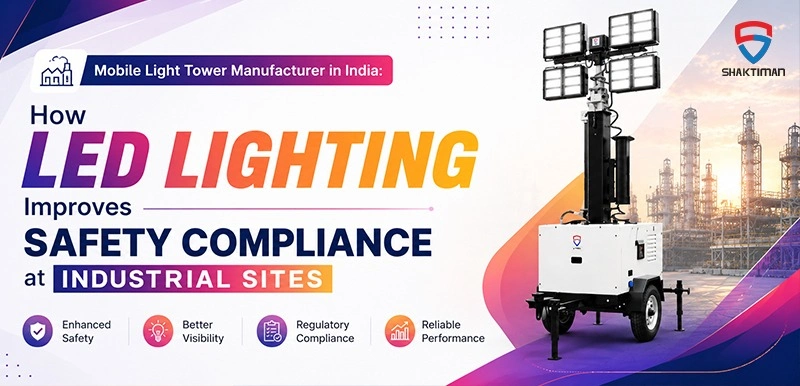
This shift is exactly why demand for a reliable mobile light tower manufacturer in India has grown so sharply over the last few years.
What Is a Mobile Light Tower?
A mobile light tower is a self-contained, towable lighting unit built to illuminate large outdoor work areas after dark.
It typically combines a telescoping mast, high-output lamps, a fuel or solar power source, and a compact chassis that can be towed between sites.
Unlike fixed lighting installations, mobile towers can be repositioned as a project moves — which matters enormously on sites where the active work zone shifts week to week.
Reference range across Shaktiman’s diesel, hybrid, and solar mobile light tower builds
LED vs Metal Halide: Why the Shift Matters for Safety
Older light towers relied on metal halide lamps. They worked, but they came with real drawbacks.
Metal halide lamps run hot, consume more fuel, and take several minutes to reach full brightness after startup — a dangerous gap during an emergency.
LED lighting solves each of these problems directly: instant full brightness, lower fuel draw, and a much longer service life before replacement.
Illustrative comparison based on typical field performance, not a single fixed test result
For a site supervisor, that means fewer blackout gaps, lower running costs, and less time spent on lamp maintenance — all of which translate into safer, more consistent coverage across a mobile lighting solutions India deployment.
How Mobile Light Towers Support Safety Compliance
Safety compliance isn’t a single checkbox — it’s a combination of visibility standards, equipment reliability, and documentation.
Consistent lux across the work zone
Adjustable heads make it easier to hit even coverage instead of leaving dark pockets between fixtures.
Reduced glare and shadow zones
Wider, more even beam spread avoids the hard shadows that put walkway and machinery visibility at risk.
Lower fire and heat risk
LEDs run cooler than metal halide lamps, removing one more variable on sites handling dust or flammables.
Reliability through long shifts
Dependable gensets keep towers running through extended night shifts without an unplanned dark zone.
Relative reference bands used when planning tower placement across a site — not a statutory table
Always confirm exact lux requirements against your project’s own safety plan and applicable local standards.
Modern towers increasingly ship with hour meters and service logs, making it simpler for site managers to show inspectors that lighting equipment was maintained and operational as required.
Where Mobile Light Towers Are Used Across India
Mobile light towers aren’t limited to one industry. Their use case is simple: any site that operates after daylight hours needs them.
Highway & Infrastructure
Night paving, bridge work, and tunnel construction.
Mining Sites
Pit lighting and haul road visibility.
Construction Sites
General night-shift illumination and site security.
Events & Disaster Response
Temporary lighting for large gatherings and emergency operations.
Ports & Logistics Yards
Round-the-clock loading and container movement.
Rental Fleets
Short-term deployment across multiple client sites.
Given India’s pace of infrastructure expansion — highways, metro corridors, and industrial corridors across states — the requirement for dependable, towable lighting keeps expanding along with it.
Choosing a Supplier: The Compliance Angle Most Buyers Miss
Procurement teams usually shortlist towers on price and lamp wattage first, then worry about paperwork later. That order causes problems during an audit.
01 — Mast durability under repeated cycles
A mast raised and lowered daily for months needs to hold its rating without drifting — misaligned heads create the uneven lighting audits flag.
02 — Power you won't be troubleshooting at 2 a.m.
Genset downtime creates a dark zone until someone reaches it — engine brand and local service response time matter more than spec sheets suggest.
03 — LED output that's independently verifiable
Ask for lumen and IP rating documentation, not just marketing claims — auditors increasingly want this on file.
04 — Support coverage, not just sales coverage
A vendor with reach across your project’s states — not just the HQ city — prevents multi-week delays when a part fails.
05 — Paperwork that survives an audit
Datasheets, lux charts, and service logs ready before an inspector asks save far more time than chasing them down afterward.
Why Shaktiman Is a Trusted Mobile Light Tower Manufacturer in India
Shaktiman builds mobile light towers specifically for the demands of Indian industrial and infrastructure sites — from highway projects to mining operations.
Our towers are built around durable mast and chassis engineering, paired with high-output LED fixtures designed for even, glare-reduced coverage across large work zones.
Hybrid MLT fuel efficiency. Shaktiman’s hybrid towers switch automatically between solar and diesel power, cutting diesel consumption by up to 60% against conventional diesel-only light towers.
Because Shaktiman’s manufacturing and service footprint is built for India’s operating conditions — heat, dust, rough terrain, and long duty cycles — site teams get equipment engineered for the realities of Indian sites, not adapted from a different climate or use case.
For teams that need a mobile light tower manufacturer in India they can rely on through multi-year projects, that combination of engineering and service support is what makes the difference.
People Also Ask
Pricing varies based on mast height, LED wattage, fuel type (diesel, hybrid, or solar), and genset brand. Buyers typically request a quote based on their specific site lighting requirement rather than relying on a flat published price.
This depends on tank capacity and fuel efficiency. LED towers generally run longer between refuelling than older metal halide units, since LED fixtures draw less power for the same brightness.
For most modern applications, yes. LED towers use less fuel, produce more consistent light output, and generate less heat, which improves both operating cost and site safety.
Required lux levels vary by task and zone — general work areas typically need lower lux than active machinery or vehicle movement zones. Site safety officers usually reference project-specific safety plans or applicable standards to set the correct level for each area.
Yes. Solar hybrid light towers are increasingly used for sites where fuel logistics are difficult or where a project wants to reduce diesel dependency, often paired with battery storage for overnight use.
Shaktiman’s masts range from 6–15 metres depending on configuration, extending or lowering in stages and rotating a full 360° to suit the focus area. Larger sites often use a taller mast to reduce the total number of towers required.
Ready to spec a mobile light tower for your site?
Share your area, operating hours, and site conditions — Shaktiman’s team will recommend the right mast height, power configuration, and LED setup.
Diesel · Hybrid · Solar | PAN-India Service | 25+ Years Manufacturing
Recent Comments