


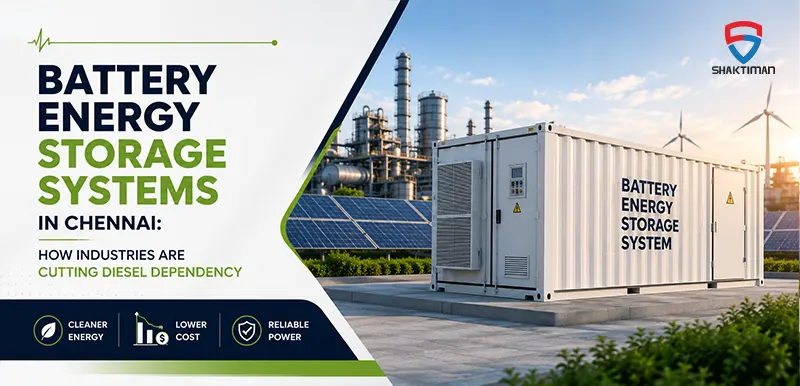
Battery Energy Storage Systems in Chennai are becoming an increasingly practical solution for industries that want to reduce their dependence on expensive and polluting diesel generators. As electricity demand grows and more businesses invest in renewable energy, battery storage is changing how industrial facilities manage backup power.
For factories, warehouses, IT facilities, commercial buildings and other energy-intensive operations, Battery Energy Storage Systems in Chennai can help reduce diesel consumption, improve power reliability and make better use of solar energy.
Tamil Nadu is also moving quickly toward greater energy-storage adoption. The state has been developing a stronger framework for BESS deployment as renewable energy capacity expands, while national policies are supporting large-scale energy storage growth.
Why Chennai Industries Have Traditionally Depended on Diesel Generators
Diesel generators have been the standard backup power solution for decades. When the grid experiences an interruption or when reliable power is required for critical operations, a DG set can provide electricity quickly.
However, diesel dependency comes with serious disadvantages.
Industrial businesses must deal with:
- Rising and unpredictable diesel costs
- Fuel transportation and storage requirements
- Regular generator maintenance
- Noise and air pollution
- Carbon emissions
- Space requirements for DG infrastructure
- Increasing pressure to adopt cleaner energy solutions
For a business that uses a generator frequently, diesel is not simply a backup expense. It can become a significant operating cost.
This is where Battery Energy Storage Systems are changing the equation.
What Is a Battery Energy Storage System?
A Battery Energy Storage System (BESS) stores electricity in batteries so that it can be used later when required.
A typical industrial BESS includes:
- Battery modules or battery racks
- Battery Management System (BMS)
- Power Conversion System (PCS)
- Energy Management System (EMS)
- Safety and thermal management systems
- Monitoring and control equipment
The system can charge when electricity is available and discharge when the facility needs power.
For example, an industrial facility can charge its battery using solar energy during the day and use that stored electricity later during peak demand or during a power interruption.
This flexibility is the main reason BESS is becoming attractive to commercial and industrial users.
How Battery Energy Storage Systems in Chennai Reduce Diesel Dependency
1. Batteries Can Provide Instant Backup Power
One major advantage of battery storage is response speed.
When a power interruption occurs, a properly designed battery system can respond almost immediately. This makes BESS particularly useful for facilities with sensitive equipment or operations that cannot tolerate interruptions.
Depending on the system design, the battery can:
- Support critical loads
- Provide temporary backup power
- Reduce the time diesel generators need to operate
- Work alongside an existing DG set
Instead of running a large diesel generator for every short-duration interruption, a battery can handle the immediate requirement.
The generator can then be used only when longer backup duration is necessary.
2. BESS Can Reduce Generator Runtime
Many industries do not need their diesel generators running continuously at full capacity.
A facility may experience short power interruptions, temporary demand spikes or periods when only essential loads need backup. Running a large DG set for these situations can be inefficient.
A Battery Energy Storage System can reduce unnecessary generator operation.
For Example : Grid interruption → Battery provides immediate power → Critical operations continue → DG starts only if extended backup is required.
This hybrid approach can significantly reduce generator runtime in suitable applications.
However, businesses should not assume that every BESS will completely eliminate the need for diesel. The correct solution depends on the facility’s load profile, outage duration and required backup time.
Using Solar Energy More Effectively
Chennai receives substantial solar potential, and many industrial and commercial facilities are installing rooftop or captive solar systems.
The challenge is simple: solar generation and electricity demand do not always occur at the same time.
A factory may generate excess solar electricity during the afternoon but require more electricity later in the evening.
Without storage, part of that energy opportunity may be lost or may not provide maximum value to the business.
BESS helps by storing available energy for later use.
A typical solar-plus-storage model can work like this:
- Solar panels generate electricity during the day.
- The facility uses solar power for immediate consumption.
- Excess available energy charges the battery.
- The stored electricity is used later when demand increases.
- The system reduces dependence on grid power or diesel generation.
Tamil Nadu’s energy transition is creating a stronger need for storage because solar and wind generation are variable. Chennai’s Climate Action Plan also identifies insufficient energy storage as a major challenge for wider renewable-energy adoption.
Peak Demand Management for Industrial Facilities
Diesel dependency is not the only issue that BESS can address.
Industries often experience periods of high electricity demand. These peaks can increase energy costs and place additional pressure on the facility’s electrical infrastructure.
A battery can support the facility during high-demand periods through a strategy commonly known as peak shaving.
For example, if a manufacturing facility normally consumes 2 MW but temporarily reaches 2.5 MW during a production peak, the battery may supply part of the additional requirement.
This can help businesses:
- Manage peak demand
- Reduce pressure on transformers and electrical systems
- Improve energy planning
- Optimize electricity consumption
The exact financial benefit depends on the applicable tariff structure and the facility’s consumption pattern, so a detailed energy analysis is essential before investing.
Industries in Chennai That Can Benefit From BESS
Battery storage is not suitable for every business in the same way. The strongest use cases are generally facilities with high electricity consumption, critical loads or frequent generator operation.
Potential applications include:
Manufacturing Facilities
Manufacturing operations can use BESS for:
- Backup power
- Peak demand management
- Solar energy storage
- Reduced generator runtime
Warehouses and Logistics Facilities
Large warehouses may need reliable electricity for:
- Lighting
- Refrigeration
- Automation systems
- Material handling equipment
- Security infrastructure
Battery storage can provide targeted backup without immediately relying on diesel.
Data Centres and IT Infrastructure
These facilities require extremely reliable power.
BESS can support critical loads and complement existing UPS and backup power infrastructure.
Healthcare and Critical Facilities
Hospitals and similar facilities require uninterrupted electricity for essential equipment.
Battery systems can provide fast-response power while longer-duration backup systems are activated.
Commercial Buildings and Campuses
Large commercial properties can use BESS to manage electricity demand, support renewable energy integration and improve backup power resilience.
Why BESS Is Becoming More Relevant in Tamil Nadu
The broader policy and market environment is also moving toward energy storage.
At the national level, India has introduced multiple policy measures supporting Battery Energy Storage Systems, including viability gap funding initiatives and a framework for expanding energy storage deployment. Government policy also encourages cleaner alternatives to diesel-based backup solutions.
Tamil Nadu is also actively developing its storage ecosystem. In 2026, TNERC moved forward with BESS-related regulations, and the state has approved significant battery storage capacity at multiple transmission substations.
This does not mean every Chennai business should immediately buy a battery system. It means the technology and regulatory environment are becoming increasingly relevant to industrial energy planning.
How Industries Should Evaluate a Battery Energy Storage Project
The biggest mistake businesses make is selecting a battery based only on its advertised capacity.
A proper BESS project should begin with an energy assessment.
Before installing a system, analyse:
- Current electricity consumption
- Peak demand
- Diesel generator operating hours
- Fuel consumption
- Frequency and duration of outages
- Critical and non-critical loads
- Solar generation profile
- Available installation space
- Required backup duration
- Future expansion plans
A facility with frequent five-minute interruptions requires a different system from a factory that needs eight hours of backup power.
Battery capacity, discharge power and system configuration must match the actual operational requirement.
The Best Approach: BESS and Diesel Hybridisation
For many industries, the most realistic transition is not immediately replacing diesel completely.
A hybrid energy strategy may be more practical.
This can combine:
- Grid electricity
- Solar power
- Battery energy storage
- Existing diesel generators
The Energy Management System can determine which source should be used based on demand, battery availability and operating requirements.
The objective is straightforward: use diesel only when it is genuinely necessary.
This approach can help businesses gradually reduce fuel consumption without compromising operational reliability.
Conclusion
Battery Energy Storage Systems in Chennai are becoming an important part of the industrial energy transition. Instead of depending entirely on diesel generators, businesses can use stored electricity to manage short outages, support critical loads, store solar energy and reduce generator runtime.
The strongest opportunity is not simply replacing one power source with another. It is creating a smarter energy system that combines the grid, renewable energy, batteries and backup generation.
For Chennai industries facing rising fuel costs and increasing pressure to improve sustainability, BESS offers a practical path toward lower diesel dependency. But the economics must be evaluated facility by facility.
A poorly sized battery system can become an expensive asset. A properly designed system, based on real load data and operational requirements, can improve resilience while reducing unnecessary diesel consumption.
Frequently Asked Questions
1. What is a Battery Energy Storage System?
A Battery Energy Storage System, or BESS, stores electricity in batteries and supplies it when required. It can be used for backup power, peak demand management and renewable energy storage.
2. Can a BESS completely replace a diesel generator?
Not always. Whether a battery can replace a diesel generator depends on the facility's load, required backup duration and battery capacity. In many cases, a BESS works alongside an existing generator to reduce diesel consumption.
3. How do Battery Energy Storage Systems in Chennai help industries?
They can provide fast backup power, reduce generator runtime, store solar energy, support critical loads and help manage periods of high electricity demand.
4. Can BESS be combined with rooftop solar?
Yes. Solar-plus-storage systems allow businesses to store available solar energy and use it later when solar generation is lower or electricity demand increases.
5. Which industries should consider battery energy storage?
Manufacturing facilities, warehouses, commercial buildings, data centres, healthcare facilities and other businesses with significant electricity demand or critical power requirements may benefit.
6. Is BESS suitable for every industrial facility?
No. A battery project should be based on detailed load analysis, backup requirements, energy tariffs and the facility's operating pattern. System sizing is critical to achieving a worthwhile return on investment.
Recent Comments