
Table of Contents
- 01 — What Is a Battery Forklift, Exactly?
- 02 — Lead-Acid vs Lithium-Ion: The Real Difference
- 03 — Why Chennai Warehouses Are Switching to Lithium
- 04 — What It Really Costs: Purchase Price vs Long-Term Ownership
- 05 — Charging Infrastructure: What You'll Actually Need
- 06 — Choosing the Right Battery Forklift for Your Facility
- 07 — Maintenance & Safety Considerations
- 08 — Industries in Chennai Already Making the Shift
- 09 — Choosing a Supplier: What Most Buyers Miss
- 10 — People Also Ask
Battery Forklifts Are a Fleet Decision, Not Just a Purchase
Most facilities don’t get this wrong because managers are careless.
They get it wrong because nobody walks them through total cost of ownership before the invoice is signed.
That’s exactly why picking the right power source is one of the most consequential — and most overlooked — decisions in setting up efficient warehouse operations.
What Is a Battery Forklift?
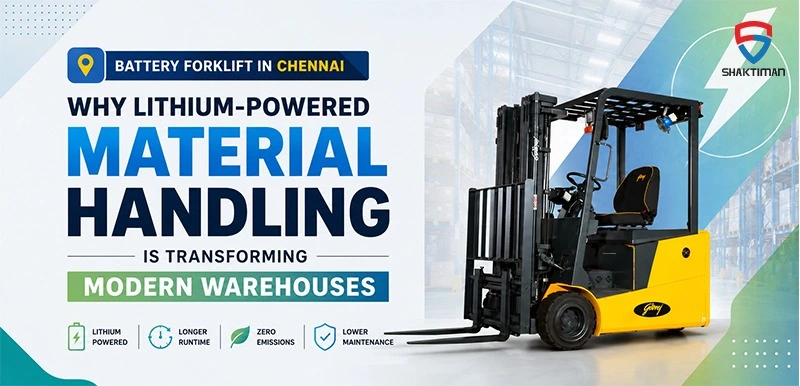
A battery forklift is an electric lift truck powered by a rechargeable battery pack instead of diesel, petrol, or LPG.
It typically pairs a rechargeable power cell with a high-output motor, delivering the same lifting capability as fuel-powered trucks, minus the fumes and fuel logistics.
Unlike lead-acid installations of the past, today's lithium-powered battery forklifts can be deployed almost anywhere on a site without a dedicated charging room.
Charging Time by Battery Configuration
Reference range across lead-acid, hybrid, and lithium-ion battery forklift builds.
Lead-Acid vs Lithium-Ion: Why the Shift Matters for Uptime
Older battery setups worked, but they came with real downsides.
Lead-acid batteries need long charge windows, constant watering, and a dedicated ventilated room to operate safely.
Lithium-ion removes almost every one of those constraints, while delivering steadier power across the entire shift.
Lithium-Ion vs Lead-Acid — Relative Performance
Illustrative comparison based on typical fleet performance, not a fixed test bench.
Why Chennai Warehouses Are Switching to Lithium
Chennai’s industrial base runs on tight shift schedules and high throughput. A few local realities are pushing the shift toward lithium specifically:
- Multi-shift operations across Chennai's industrial belt, where opportunity charging replaces two or three lead-acid battery swaps
- Expensive floor space near Guindy, Ambattur, and Sriperumbudur, freed up by removing the dedicated battery room
- Tightening indoor air quality expectations across food-grade, pharma, and electronics facilities
- Chennai's high ambient heat, which lithium systems tolerate more consistently than lead-acid
How Lithium Power Supports Warehouse Uptime
Consistent Power Output
Steady voltage across the full discharge cycle keeps lift speed and performance constant.
Fast & Opportunity Charging
Top up in short bursts during breaks without damaging the cells or shortening lifespan.
Lower Maintenance Load
Sealed cells mean no watering, equalizing, or acid handling for staff.
Longer Service Life
2,000-3,000+ charge cycles, often stretching to 5-10 years of service.
Typical Site Use Priority
Reference bands when planning battery type against how a facility actually operates.
What It Really Costs: Purchase Price vs Long-Term Ownership
Lithium-ion battery forklifts cost more to buy than lead-acid equivalents — that’s the honest starting point.
Where lithium wins back the difference:
- No spare batteries needed — lithium often needs just one battery per truck versus 2-3 for lead-acid multi-shift fleets
- Lower maintenance labor — no watering schedules or specialized battery-room staff
- Longer service life — 5-10 years versus 3-5 years for lead-acid
- Higher uptime — fewer swaps translate into more productive forklift-hours per rupee spent
Industries in Chennai Already Making the Shift
Auto Components
High-throughput, multi-shift plants around Sriperumbudur and Oragadam.
Electronics Manufacturing
Cleanroom-adjacent facilities favoring fume-free, low-maintenance operation.
FMCG & Cold-Chain
Fast pallet turnover across shifts where swap time is a real cost.
Port-Linked Logistics
Continuous operation windows near Chennai and Ennore ports.
Choosing a Supplier: What Most Buyers Miss
Procurement teams usually shortlist vendors on price and setup wattage first. That leaves the questions below unanswered until it’s too late.
01 — Sizing Beyond the Spec Sheet
A vendor should be able to size the battery and charger to your actual shift pattern, not sell a standard package regardless of fit.
02 — Support You Won't Need at 2 A.M.
Genuine after-sales presence in Chennai matters more than a call center response line when a truck goes down mid-shift.
03 — Warranty That's Independently Verifiable
Ask for battery and forklift warranty terms in writing, separate from marketing copy.
04 — Spare Parts Coverage, Not Just Sales Coverage
A vendor with reach into project sites matters more for the life of the fleet than aggressive pricing at signing.
05 — Real Installations That Survive an Audit
Ask for references, site visits, and service logs before committing to a fleet-wide rollout.
Planning a Battery Forklift Rollout in Chennai
Whether you’re weighing a single-truck upgrade or planning a multi-shift fleet transition, matching battery chemistry to your actual operating pattern is what determines whether the investment pays off in year one or year five.
Getting the sizing, charging infrastructure, and supplier support right matters more than the battery chemistry alone.
People Also Ask
Ready to Spec a Battery Forklift for Your Site?
Share your shift pattern and site conditions — get a straight recommendation on lead-acid vs lithium for your operation.
Recent Comments